
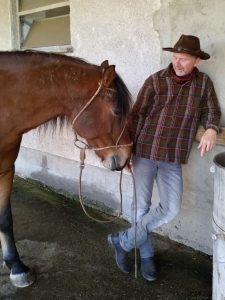
Aequilibrium, context, method, and effect
The name of my method derives from the Latin word for balance, as you have certainly recognized. It is a system of exercises that are performed with horses. It is, therefore, suitable only for those who are drawn to horses or who already own horses and for people who, despite fear or skepticism, are willing to open up to these special animals.
I would like to detail why I have chosen balance as the central message. Body and mind are in close resonance with each other, a healthy body promotes a clear mindset, and a stable psyche has a positive effect on physical well-being. The effectiveness of Aequilibrium is based on this. Balance is not a static state that must be achieved to feel good, but rather a state that can be fostered through appropriate behavior. It is akin to a pendulum constantly swinging around its center. The aim is to reduce the pendulum swing and thus stay closer to the desired ideal. The more mentally and physically stable you are, the fewer challenges, problems, and illnesses can bring you down, so much so that your inner pendulum can reach your ideal state or comfort zone for only a short time or not at all. For this, we need balance, which includes healthy self-confidence, because the two work as mutual supports. I will describe later practical patient observations on this topic.
Balance through self-confidence, self-confidence through balance
Horses speak a common language, but they each have their own dialect.
They allow us to communicate within their physical and emotional character traits, which may be similar within a breed but are pronounced and weighted differently from one animal to another. Therefore, it is the rider who must learn to understand the characteristics of his companion and apply this knowledge as a basis for friendly communication. This requires a high degree of empathy, patience, and, ideally, healthy self-confidence. So let us now move on to working with horses and what this means in practice.
Why self-confidence and what exactly does it mean?
Horses are animals that run and seek to follow a superior, strong leader on whose wisdom and courage the survival of the other members of the herd may depend. With their heightened sensitivity, they also recognize insecurity and weakness in us humans, so it is difficult to gain a horse’s trust and loyalty unless it is decided to use technical (coercive) means.
However, this certainly does not create confidence; on the contrary, there is an atmosphere of tension from which the horse breaks away as soon as the limit of its mental resistance is reached. This is how riding accidents happen.
From a spiritual point of view, healthy self-confidence is a fundamental condition. It is the basis of our stability, resilience, and inner strength. Too often, it can be confused with self-centredness. What I mean is a self-image based on knowing and accepting one’s weaknesses and strengths in equal measure, as well as a willingness to learn and let go of what turns out to be wrong or destructive. Accepting one’s weaknesses underpins tolerance of others and is the basis for a relationship of forgiveness, accommodation, and empathy. This empathy is important in the relationship with the horse; trust builds trust.